 Digital Composition Studios
  Home »
Events Calendar
November 30th, 2019
McGill Contemporary Music Ensemble - : Guillaume Bourgogne, Artistic Director and Conductor
Pollack Hall
7:30pm
Quick Links
|
| |
|
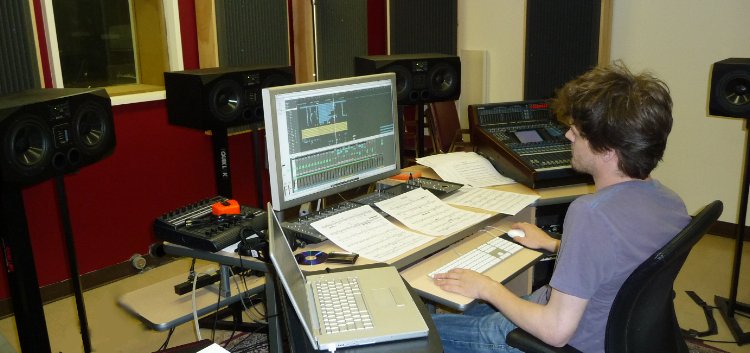
September 11th, 2017 Graham Sommer Competition for Young Composers August 29th, 2017 Welcome to Georgia Spiropoulos, Distinguished Visiting Chair in Music (Composition) and Acting Director of the Digital Composition Studios for the 2017/18 academic year. Born in Athens - Greece, 1965. She studied classical piano, harmony, counterpoint and fugue in Athens and she worked as a performer, arranger and transcriber of Greek oral-tradition music. She moved to Paris in 1996 where she studied composition & electroacoustic music with Philippe Leroux, form analysis with Michael Lévinas and computer music at IRCAM (with Jonathan Harvey, Tristan Murail, Brian Ferneyhough, Marco Stroppa, Philippe Hurel and Ivan Fedele) and at the "Advanced Studies in the Social Sciences" (EHESS, Paris) with Marc Chemillier, Pierre Judet de la Combe and Francis Zimmermann. She won the "Villa Médicis Hors les Murs" prize for NYC and she has been made Knight of the Order of Arts and Letters of the French Republic. Georgia Spiropoulos collaborates regularly with IRCAM where she has been working as a composer-in-residence. She gave lectures and master classes at Columbia University NY, University of California Santa Barbara, IRCAM, Hochschule für Musik und Theater München, University of Paris 7 and Paris 8, ICMC and SMC International Conferences, Paris Conservatory CRR, Tel Aviv Conservatory, Alte Schmiede-Vienna, French Institut of Athens. She writes articles on contemporary music and she has been a jury member for the ICMC and SMC International Conference and for IRCAM Cursus and artistic research residences. She is the Instructor of: MUCO341-Digital Studio Composition I, Fall 2017 The McGill 'Digital Composition Studios' ( formerly the 'Electronic Music Studio' ) was founded in 1964. As part of the Composition Area, it plays a vital role within the Schulich School of Music at McGill University. Its mission is to promote and facilitate all activities within the School of Music that involve the creative and applied use of music technologies. As such, it is a meeting place for students, faculty members, and visiting artists and researchers in composition, performance, music technology and sound recording. Activities within the Digital Composition Studios include teaching at the undergraduate and graduate levels, compositional projects, performance of works involving technology, creation/research activities (including CIRMMT artistic and research projects), and collaborative projects, as well as supporting events at the Schulich School of Music as required. Prospective students should note that the Composition Area does not offer a program exclusively in electroacoustic or computer music composition. All students are expected to be proficient in instrumental composition, although extensive opportunities do exist to work with a wide range of approaches to music technology, including mixed works, interactive composition, gestural controllers, acousmatic works, multichannel audio, computer-assisted composition and more. The DCS is one of three areas within the Schulich School of Music that explore the interaction of music and technology. The other two are the Music Technology Area and the Sound Recording Area. The Digital Composition Studios (DCS) comprise three large composition studios and three smaller project studios. List of Equipment for concerts and rehearsals. more List of Controllers/Intruments. more List of Printing/Binding equipment more |
© 2008-19, Digital Composition Studios. All rights reserved.
Design-Richard McKenzie, inspired by GetTemplate
DCS logo- Eliot Britton/Richard McKenzie, DCS doodle David Adamcyk